We Changed a Beach
by Hilary Burden “Ten Days on the Island is recognised as Tasmania’s most consistent and significant contributor to the...
One autumn evening in Launceston, I walked down the hill from my share-house to the Seaport. There – where the mouth of the North Esk River flows into the estuary of the Tamar – I watched a Chinese junk ship float past. Pictures and videos were projected onto the boat’s sails. The contents of these flickering images are now completely lost to memory, but I still carry a residual sense of the experience of seeing this strange marvel, kitted out for a mysterious purpose, drifting on the waterway I knew so well, as the sun sank behind the Launceston suburbs.
I was 20 years old. At the time, my relationship with Tasmania was defined by limitation as much as by any sense of loyalty. It could be said that I had stuck around, when so many other mates left, because I lacked dreams that reached further. But finally, as I grew into adulthood, ambitions were starting to stir within me. I was scanning distant horizons for the source of my future identity. I figured I would only find it by leaving the island.
The weekend before Junk Ship sailed into Kanamaluka, I went to the Queen Victoria Museum & Art Gallery, where a set of curious structures had been installed in a gallery room. This was Ray Lee’s Siren: tripods with rotating heads that emitted bands of light and droning noises as they moved. Visitors were encouraged to wander through the tripods; I took full advantage of this, leaning and crouching, even jumping, to discover what sonic effects could be found or made.
For me, this work was a revelation. Not only had I never experienced sound art, I didn’t know that such experimentation could really be called art. I hadn’t seen a performance that allowed the audience to walk through the work – even to participate with it, or play within it. This was the kind of installation that people talked about seeing in big cities, and yet here it was, installed in a familiar setting.
It all reads as if I had a very reduced world, but that’s how it felt. My first rendezvous with Ten Days on the Island was an invitation to create. The message I received was that it was possible to make out-of-the-ordinary art in Tasmania. It cannot be underestimated how much I needed to be given this permission.
It gradually dawned on me that it wasn’t only that creative thinking was permitted, but that an important role in the life of the island was centred around imaginatively-told Tasmanian stories.
I had always been interested in stories. I plucked them promiscuously from wherever I found them, even though I didn’t yet know what to do with them. After my introduction to festival-based art, I started to think about what I could do with storytelling. I thought not only about the words that I wanted to speak, but who might listen to them and what the stories might come to mean if an audience was invited to share in them.
As I began to travel within Tasmania, I concluded that you could find an interesting yarn in every square inch of the place. The first artistic director of Ten Days on the Island, Robyn Archer, made a similar discovery when she came to the role from Adelaide. As a warm-up for the job, Archer made a ten-day itinerary around Tassie. This journey gave the festival its shape.
The road trip is still embedded in the ethos of Ten Days’ programming. I am always delighted to flick through the festival’s program brochures, knowing that I’ll be tempted – with other punters – to unusual venues and out-of-the-way places. It’s a festival that rewards the intrepid. As Robyn Archer described the original vision: “a unique aspect was that if you wanted to see the entire festival, you would need to travel around the island.”
Those in Tassie’s urban centres don’t miss out altogether, but there is always an incentive for many art-lovers to venture off the beaten track. The other, glittering side of that coin is that if you live in a rural town, Ten Days on the Island brings the event to you. This is especially notable for young people in country towns, who may find the expense and logistics of getting to gigs prohibitive.
I thought of this a lot in 2021, when I was employed by Ten Days on the Island for the first time. A feature of that year’s festival was a showcase of our country towns’ small halls. My assignment was based at Liffey: I wrote an essay about their community hall (published in Island magazine) and then hosted a festival event there. We created a makeshift stage on the back of a truck, where a handful of poets and musicians performed. It was a blustery day but not even the katabatic winds off Drys Bluff could quell the enthusiasm of either locals or touring performers.
Another director of previous Ten Days festivals, Elizabeth Walsh, pointed out the subversive nature of a Tasmanian event curating international acts. Simply claiming the right to host major arts events was not really on our radar when the festival began in 2001; it was as though we had conceded that only the big mainland cities could hold that privilege. The fact that these high-quality productions are subsequently staged in farm sheds, formal gardens, empty shop fronts or planetariums up-ends the norms even more.
Of course, this can be done in a messy way – the inhabitants of regional Tasmania aren’t always receptive to guests who rock up uninvited – but my observation is that Ten Days on the Island has a knack for matching touring artists with their local hosts. There is a kind of alchemy that all event curators must aim for when they bring together artists and audiences. Of all the ingredients that must come together to make the reaction of festival magic, consideration and time are the most crucial.
Underpinning curatorial decision-making is the awareness that artists are not only collaborating with other people, but also with the places themselves. It’s a level of respect for the nature of a place that is often forgotten in events programming elsewhere.
For the 2025 festival, I worked – and walked – alongside author Ailsa Piper, who flew in from Sydney. Ailsa ran a writing workshop in the Botanical Gardens, drawing creativity from our surrounds. Her sensitivity to this much-loved Hobart environment was a literal example of what invited performers almost invariably discover: venues, and the landscapes around them, will also offer their input into any Ten Days exhibition, event or performance.
My own belief is that Tasmania is a potent setting for experiments in cross-cultural conversations. This may seem counter-intuitive, but for me, every aspect of our island life – idiosyncrasies created by isolation, our unique flora and fauna, and our sense of remoteness – makes Tassie an ideal laboratory for thoughts that affect the whole of humanity.
That much was clear in conversation with Ailsa Piper. We found much to discuss and filled the gaps between our sessions with boisterous conversation. It was the kind of dialogue that must happen among artists at each and every festival.
As an artist, I find it inspiring to think about what we have to offer our planet. The challenge beckons: to translate Tasmanian themes for a wide audience and explore the curious links that connect us to the rest of the world. Likewise, I love seeing what visiting artists have to share with us – what messages or concepts travel well, and hit the spot, even when they’re staged or exhibited on a far-flung island at the bottom of the world.
There is a beautiful texture to the festival’s programming. It weaves intensely local experiences – which can be gritty and coarse, but stitched tightly together – with well-rehearsed, world-renowned acts, which may be more akin to a length of silk. The effect is wonderful. Audiences get a look at world-class shows; emerging artists and community events are given a new level of legitimacy; and Tasmanians are reminded that our best work stacks up with whatever else is going on in the world – which, for a state that has long suffered from a lack cultural confidence, can be a dramatically liberating opportunity.
I get particularly excited about the long-term, multi-faceted roles that the festival offers. Artists are commissioned to create work across more than one iteration of the festival; we are urged to go beyond the bounds of our usual practice. The festival’s encouragement has allowed some individuals to flourish wildly.
Having my name listed on a festival program alongside an established Australian writer like Ailsa Piper has boosted my credibility outside of Tasmania. The pursuit of this reputation is, in my experience at least, one of the hardest parts about choosing to stay on the island. That every second year Ten Days on the Island gives arts practitioners of all kinds an exceptional chance to find a new audience – or to demonstrate their growth to a local audience, who may sometimes take for granted local performers and artists.
The resilience of our creative community relies on opportunities like this.
All art practices allow different voices to take centre stage, in a way that doesn’t come naturally to other fields of life. The array of artists named in a Ten Days on the Island program is always exhilarating. This includes overseas visitors (the names, literally, can be enthralling in themselves) but also Tasmanians, especially those who are sometimes marginalised or overlooked.
Significantly, many artists are Aboriginal Tasmanians. Countless festival attendees have been given an insight into Palawa/Pakana perspectives thanks to works created for Ten Days on the Island. An example of this is the series of mapali works presented by David Mangenner Gough across several iterations of the festival. These events amplified Gough’s personal perspective but, at the same time, mapali was a deeply Tasmanian event, telling a story that included everyone who chose to participate.
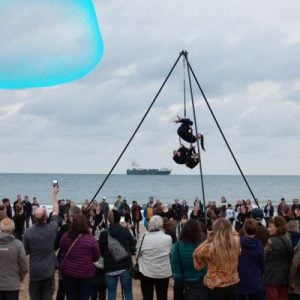
In 2021, mapali – Dawn Gathering brought a thousand people together for the festival opening event on the main beach in pataway/Burnie. However, many more were involved in producing various elements of performance and place-making, creating clapsticks and dogwood shelters, among other things.
A case study into mapali – Dawn Gathering gives a good insight into what an experience like this effect. Interviewees pointed out how hands-on participation had given attendees a sense of ownership over the event. Such experiences build community pride and also cultivate a broader sense of belonging. Through events like mapali, Tasmanians become more inspired by our island’s Aboriginal history, as well as the potency of present-day Aboriginal identities.
Experiences of art are naturally inclined to encourage us to share emotion across cultural divides. Those who were on pataway beach for mapali – Dawn Gathering described the same boundary-dissolving euphoria. There is nothing quite like sharing a powerful moment with strangers.
As has been pointed out in major studies – such as the 2022 Australia Council for the Arts paper Connected Lives: Creative solutions to the mental health crisis – involvement with arts practices and events have a major effect on individual mental health, as well as on social cohesion. Relationships are built and deepened; participants and observers can be empowered to change their lives or explore new facets of their identity. I cite just a few statements from the research, the ones that are most familiar to me. As both performer and punter, arts festivals have helped me consolidate my identity and develop a diverse social network.
I like how Wesley Enoch, Chair of Creative Australia, puts it: “If you don’t know your stories it is impossible to feel connected to the place you call home. If you don’t share your stories you are likely to feel disenfranchised, disconnected and discombobulated.” Festivals like Ten Days on the Island create a space where the intricate threads of community storytelling can be followed – and where we find that we have common than we might have expected.
My own journey has certainly been one of diminishing discombobulation. Though it is my own story, it will not be unfamiliar to many Tasmanians who have been given an opportunity to work in arts, community and cultural events.
Despite the leaps and bounds that have occurred in our state’s arts scenes in the past decades, it’s still challenging to be an artist in Tasmania. Every creative person I’ve worked with has conceded periods of self-doubt and considered throwing in the towel. No doubt, the challenge is always in front of those who develop structures to support us – and by ‘us’ I mean the motley cohort of individuals that make creative work in Tasmania – but the potential reward is great. We can be ambassadors for a way of life that is distinctly and proudly rooted in our island’s identity.
A central offering of my own work these days is to help people recognise familiar aspects of a Tasmanian identity. For me, this is one of the most satisfying outcomes of a performance or piece of writing. I’m confident that I have made work that matters when my audience says they saw something of themselves in the material.
It’s something I believe in deeply because works of art have been part of fostering my own connections to place – the most important relationships of my life.
by Bert Spinks
by Hilary Burden “Ten Days on the Island is recognised as Tasmania’s most consistent and significant contributor to the...
Dear friends, On summer evenings the island hums. Sea breeze in the gums, music drifting across a park, kids...
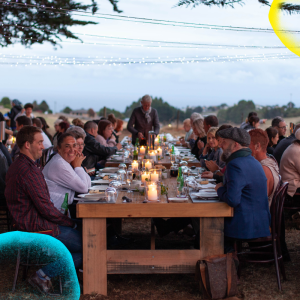
What happens when a community takes the lead in telling its own story? In Shorewell Park, a suburb of...
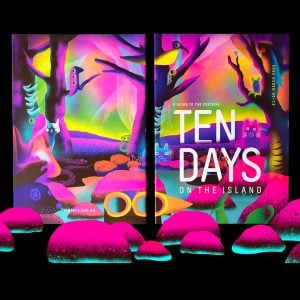
We’re thrilled to share that our design partner, Futago, has been named a finalist in the prestigious BEST Awards...