Permission To Stay
One autumn evening in Launceston, I walked down the hill from my share-house to the Seaport. There – where...
Tasmania based author Hilary Burden examines the place of Ten Days on the Island over its 25-year history, and its potential as a community change agent embedded in intergenerational wellbeing.
 by Hilary Burden
In considering the arts, I am a Bachelor of them. The humanities are a much-derided career path in this century, and BA’s do not make millionaires. But that’s not what we sign up for; and it wasn’t the main point, graduating from the University of Tasmania in the 1980s with a certificate rolled in blue ribbon. Instead, it was a path to free thinking and creative self-expression which led to a professional career as a journalist, writer, broadcaster, editor and now perfumer. Experience on two continents over four decades followed. I’ve authored several books, edited others.
But when I sat down to write this essay, it was the first time in my writing life that an uninvited “Co-pilot” inserted itself at the top of the blank document, with these words.
Describe what you’d like to write.
Write a funny poem to wish happy birthday to my five-year-old sister.
Write a bedtime story for an eight-year-old about dinosaurs.
Create an article about how to effectively volunteer for a non-profit organisation.
An Irish poet once told me that to be a great one, the writer “must make friends with the blank page”. Even though it may be an effort, often herculean, to create something that is original, thought provoking, and innovative, that you may not be paid for, and that, to paraphrase the words of Dorothy Parker, necessitates nailing your butt to the chair, the true artist will do it anyway. They can’t not.
Creativity cannot be dictated to, force-fed, controlled, programmed or manufactured. In a bitterly cruel world, the artist (bold and vulnerable), works hard, really hard, and yet it comes from somewhere else, sometimes when you least expect it, often when you’re about to give up.
The blank page must continue to be supported in all its frustrating, quixotic, whimsical mystery. Driving by myself from the front seat, asking questions of life is my profession and vocation, my love and obsession. The best artists are ever curious, always learning. We don’t need a co-pilot. To be coerced by a computer, without consent, about what to write is a blunt dull instrument, pillaging and plundering, downplaying the right to free thought.
We are an island of many adjectives evocatively tied to the immense beauty of this place. All you have to do is look. Really look. It’s our unique umbilical cord, what inspires so many of our artists and thinkers; our way of being in the world.
My upbringing here, and the focus of a midlife writing career in which I returned, as do many of us, to dedicate myself to being Tasmanian, led to an epiphany. One that helped me find my voice as an author: that Who you are is where you are. And anything that challenges the ability to understand, interpret, or celebrate this pure, wild relationship with nature – one so rare in the world – is sent to the margins.
It’s not easy. You get distracted. You also need to earn a living; each year the writer earns less while things cost more. The maths does not add up though the passion refuses to die. You find yourself waking at 3 am worrying madly if people in the future will even read books, go to plays, paint, perform, strum a guitar… Will they even continue to chase their dreams?
It’s always a surprising moment when a poem forms in your head, say, after packing up a campsite on Schouten Island at New Year. Or, after you’ve seen the Blue Love Creeper wind its way around an old Swansea fence post. Or you listen to how the green keeper saved a field of wild orchids from the council mower at the Campbell Town golf course. A poem takes form in the subconscious and somehow it holds a truth.
Before a word is written, the ground is primed. What I THINK I want to say is considered, thoughts scribbled by hand on Post It notes, endless pieces of research heard, read, picked up like a bird making a nest. And then it happens, in the moment you sit down to write, blind faith in the blank page. Hopefully words that make sense, haven’t been said before, that fulfils the brief if there is one, that resonate with the reader who then proceeds to steal them into their own heart. The writer never minds. It’s why we write.
And so, sitting down to write this essay, a rose gold sun rises over The Hazards, pink faced Monday morning. Green parrot perched on the veranda railing. A humpback arcs up in Oyster Bay. Waves breathe in and out on Dolphin Sands. Swallows lark about like spitfires in dawn’s magic wand and my heart swirls this diaphanous morning because the world is alive and kind and beautiful – even though the news says it’s not.
A quarter of a century ago, when the Tasmanian Premier had a lightbulb moment, you can count on it, this scene was unchanged; sun, Hazards, parrot, whale, ocean, swallow, dawn… A quarter of a century ago, the millennium Premier, the late Jim Bacon, had seen an opera in Hobart starring Robyn Archer, then artistic director of the Adelaide festival, the biggest in the southern hemisphere at the time.
After the show, Jim took off backstage to chat with Robyn. By the time he got home that night, Jim’s wife Honey recalled that her husband’s mind had been made up, his vision formed; an international arts festival was just what Tasmania needed to grow the state’s cultural confidence.
As the story goes, Jim invited Robyn to be the festival’s founding artistic director. Who but Robyn would have invited her parents to Tassie for a ten-day tour of the island, taking in as many of the tourist hotspots and smaller places to get a feel for what a statewide festival might entail. By the end of their road trip, Robyn had decided that due to the very limited arts infrastructure outside of the main centres, other assets would need to come into play.
It’s a key dimension that has carried through the decades under several influential artistic directors: events held in unusual and surprising places, a venue prototyped that had never been used before. TasDance in Rowella Hall, Van Diemen’s Band in St Helens, epic experiences in an island-wide project If These Halls Could Talk, and Big hArt’s Acoustic Life of Sheds.
The biennial celebration of a whole of island culture became one of Jim Bacon’s government’s key initiatives, premiered in 2001 with Sir Guy Green, then Governor of Tasmania and a devoted supporter of the arts, lending his support as a visionary founding figure. Later, under Sir Guy’s chairmanship and patronage, the festival thrived, and attendance soared, reaching a record 195,000 in 2009.
At Sir Guy’s memorial in 2025 Her Excellency the Honourable Barbara Baker, Governor of Tasmania, honoured “his passion for Tasmania and its place in the world.” Just like Robyn Archer, our Governors have always made it their habit to travel all over the island to small parochial towns, somehow trying to assuage the surreal symbolism of monarchic rule from abroad and a broken promise that virtually wiped out the island’s unique indigenous culture, making friends anyway.
Robyn Archer was an inspired choice as the Festival’s inaugural Artistic Director, and in her three editions made Ten Days the MONA of its day, juxtaposing local content with high level international artists. In her passion for the arts, formed from an early age, Robyn recognises her own lightbulb moment experienced in her twenties, as lead singer in a Brecht-Weill opera. She says it taught her that “the arts are more than entertainment – they could stimulate audiences to consider the most important issues in any time and place, and in a way that was skilled and beautiful and awe-inspiring.”
There are more than enough important issues the world now faces. Anyone with heart and mind needs little reminding, from dramatic weather events caused by climate crisis to genocide in Gaza. From the creep of digital delivery and artificial intelligence to the rise of dramatic wealth inequality. From gun violence in America to the brink of war in Europe… With global politics as frightening as it is, the case for high-quality community-based arts is ever more valid. We need platforms for togetherness in physical spaces in real life that hold our memories, that help build our culture, that offer context and meaning, that inspire and connect us. That keep us friendly and continue to deepen our own sense of place.
Asked to pick some of her favourite Ten Days memories for the festival’s 20th anniversary, Robyn Archer chose, among others, Fiddlers’ Bid from the Shetland Islands, who performed at Launceston’s Albert Hall. “There was a moment when they changed tempo and riffed mid-song, and I thought the crowd was going to dance the floor apart and fall through the cracks: more sound and seat and musical exhilaration than I had ever experienced. Sometime that week they were having a drink in a small pub and jammed on a Scottish traditional ballad with the Tang Quartet from Singapore, also part of the Ten Days program that year. It was utterly moving music, entirely international and completely spontaneous.”
Lindy Hume, Artistic Director for Ten Days (2019, 2021, 2023), calls it “allowing for the moments in between”, something she says she picked up as Director of the Perth International Festival (2004-2007).
“Until then, I hadn’t realised that the festival happens in the spaces in between; accidental conversations you hear in the bar. In Perth, it was on the back veranda of the concert hall, in exactly the right summer weather, capturing that place in a perfect light. Bands were playing, four different audiences all converged at the same time. The penny dropped. ‘Oh, this is the festival!’ It’s animating the spaces in between. If you don’t have that buzz you don’t have a festival.”
A festival’s buzz is like the writer’s blank page. You can direct it all you like, create the best conditions for it to fizz, but in the end, it happens in a non-linear way, in the ether. Like the athlete’s “zone”.
In considering the role of the arts, the demise of Australia’s long-running literary magazine Meanjin after 85 years “on financial grounds”, is hopefully not a continuing trend. “Almost no literary magazines around the world are financially viable,” noted Tasmania based writer and poet Ben Walter in Guardian Australia, “that’s not their purpose. The point is their cultural value, the role they serve as a platform for ideas and creativity, for writers (artists) to hone their craft, and for readers to encounter something that doesn’t relate purely to the 24-hour news cycle.”
Twenty-five years ago, when Ten Days was launched, there was no Facebook, no iPhone, no mainstream AI, no attention economy, clickbait or streambait. Google was barely a toddler, and the gaining search terms globally were ‘Nostradamus’, ‘World Trade Centre’, and ‘Harry Potter’.
Now we live in an era of digital delivery, shaped by FANGS (Facebook, Amazon, Netflix, Google, Spotify). One of Australia’s most established producer/directors, six-time Logie winning, Emmy awarded Michael Cordell says the whole media landscape has been reshaped because of FANGS… by internationally housed companies who don’t pay tax and commission little. He says the government must do something about it. That right now “Australian stories are incredibly important to tell”.
There has never been a more important time not just to tell new stories, but to keep telling the same stories in new ways, as well as the old stories that were never heard.
Like dust blown across the plain are the people of the Moon Bird
And yet there is no one to teach me the songs
That bring the Moon Bird, the fish
Or any other thing that makes me what I am.
– Japanangka errol West, poet & scholar
Stories have always been told in this place. It’s how the First Peoples existed for thousands of years. Hand painting on cave walls. Face painting with ochre. Dancing in corroboree around campfires. Making canoes from bark, necklaces from meticulously gathered shells, crafting baskets from reeds and kelp. Despite all the obstacles set by man and nature, this island breeds creative spirit.
There must be a role for our elected officials to keep our creative spirits safe, and for the privately wealthy to give back, so that our cultural stories may survive the next 12,000 years. So that the beauty of this island, and its passionately parochial people, continue to have a voice, elevated by welcoming human expression in all its diversity.
And that we celebrate it – like there’s no tomorrow.
From the audience’s perspective it also makes sense. We may be more outward looking and globalised than ever. But the fact is we are also more adrift. According to UNESCO, solving the problem of social exclusion globally is urgent.
In 2023 social cohesion in Australia was the lowest it has been since measurement began in 2007. (Scanlon Institute Social Cohesion Index). Australians have half as many close friends and know half as many neighbours than they did in the 1980s.
According to the latest annual statistical report from HILDA, a longitudinal study of Australian households, the proportion of people in psychological distress has trended upwards; between 2013 and 2025 increasing by roughly 55% in males and 46% in females. Australians have also substantially decreased their frequency of socialising over the past two decades, and young people score as lonelier.
According to Australia’s national independent arts and culture think tank, A New Approach (ANA), evidence from across the nation and the world shows that cultural and creative engagement builds belonging, trust and connection, helping people to live better, together.
Kate Fielding, CEO of ANA, says “Despite this, not all governments in Australia explicitly pursue social cohesion through cultural policy, and most policy focused on social cohesion does not integrate cultural and creative engagement.”
With Jim Bacon and Robyn Archer’s vision for building cultural confidence, community and collaboration have remained core values of Ten Days. Data produced by Australian cultural measurement platform Culture Counts shines light on the Festival’s role in enhancing social cohesion, wellbeing, and economic vitality:
And when past audiences who’ve grown up with the Festival in their lives were polled on its value, they might admit to not having seen any festival programming in the past ten years, but they took up violin after seeing a Ten Days performance.
“None of this can ever be captured in an economic review or bed nights,” says current CEO Vernon Guest.
In 2017, under then CEO Jane Haley (2015-2021), the Ten Days organisation relocated its headquarters from Hobart to Burnie, reclaiming its brand and leadership position as the key driver for and investor in new works by Tasmanian artists, and bringing quality arts experiences to audiences in regional Tasmania. The recruitment of Lindy Hume as Artistic Director established the three-weekend model for the Festival and incorporated and championed First Nations’ cultural practice.
“Away from the city we found a new voice, edge and focus,” Lindy says.
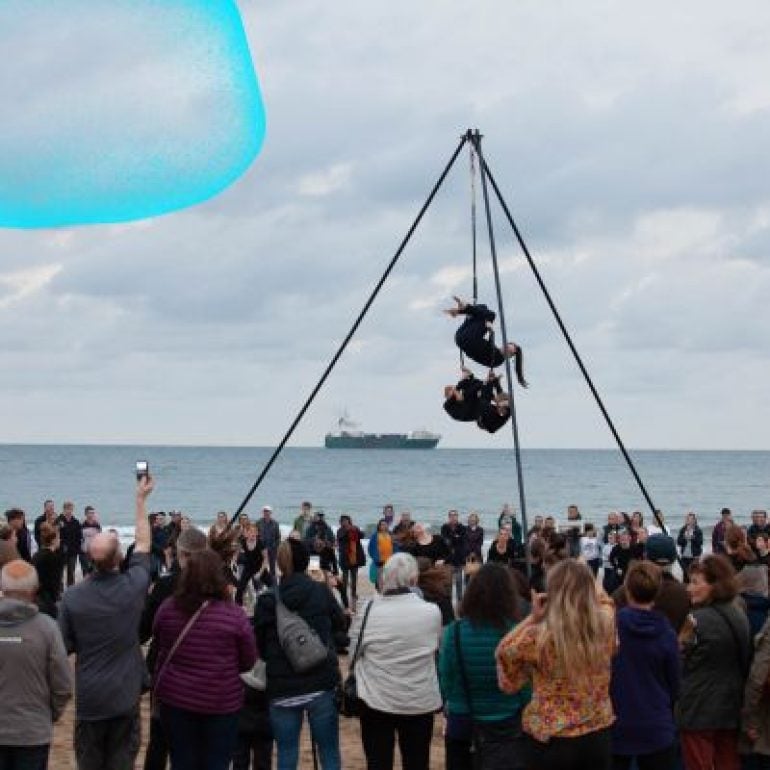
And the first mapali – Dawn Gathering was held on Devonport beach.
Created and directed by trawlwoolway artist and cultural leader David mangenner Gough, the gathering encompassed the opening celebration and launching the festival program. In 2021, mapali involved a cast of over 200 performers including First Nations elders, visual artists and performers from around Tasmania, and non-First Nations local artists, community groups, performing arts organisations, and school students. Over ten Tasmanian organisations and four North West Tasmanian schools were involved in the event performed at dawn on pataway beach, drawing an audience of over 1,000 people.
In a case study of mapali, an Australian Research Council Linkage Project found the work represented “an inclusive and highly collaborative model of artmaking, storytelling and community building, and evidences the value of art and creativity for cultural reclamation and expression.”
In his keynote address at the 2021 Regional Arts Australia conference, David mangenner Gough cited the importance of large-scale trust, “the actual trust of my community and people to say, ‘I want to be involved in this’, really to trust me to come on this journey. Everyone was part of this journey…”
One interviewee told the ARC Linkage Project that, “so many people are like ‘I was in that’, and that was the thing that I really loved…for people in the community to know that some of the things they can do and the networks they can make, they don’t have to leave home to be an artist and to be creative…
“We changed a beach. Everyone looks at the beach differently now.”
The challenge of curating festivals into the future is not for the feint hearted. But for Lindy Hume, Ten Days has proven its worth. “It’s still standing when others have come and gone, and it’s because of its authenticity. If you lose that authentic connection to community… Instead of thinking of it as a little weird festival that offers little return, it’s actually a leading festival in the world because of its connection to community. I don’t know how AI affects festivals. Ultimately, they are about humans and humanity and about people being in the same place as each other, sharing an experience and talking about it.”
In 1999 Premier Jim Bacon built on his vision as part of an ABC TV panel imagining Tasmania in the year 2020. Projecting himself a decade into the future, Bacon reflected how “the whole process of reconciliation really said about Tasmania that we want to be an inclusive community, one that recognises our history and that we are prepared as a modern society to not only work better at living together but to advance that to the stage where we can be seen as a world leader. It’s made us a more cohesive community, one where everyone in Tasmania feels they can contribute. Now in 2020 no one is excluded, everyone gets the right to have a say and to be treated as a worthy part of our community.”
Belinda Cotton, director of Tailored Services for the Arts in Tasmania with a 30-year career in the arts, believes this vision is key.
“Creating space for artists from all walks of life to expand into and create continues to be an imperative for a thriving and healthy state. Leaders of vision will see that a festival like Ten Days on the Island – hyper local and grassroots – can be a powerful driver for social cohesion. It’s a place where there is intergenerational connection and freedom to celebrate creativity, culture, food, music etc. If you’re talking about providing hope and a safe place for big ideas, festivals can do a lot of heavy lifting in this space because they’re so connected to the people and place where we live. Strategically, that’s where Ten Days on the Island can be a powerful force.”
There’s a lovely chat you’ll find on the Ten Days website – a marker of hope for the future – between Artistic Director Marnie Karmelita and permaculture educator and author Hannah Moloney. They’re riffing on why Tasmania is their happy place. Hannah says her motivation as an artist is focused on “how we turn up together”. She says, “It’s multi-generational thinking, not the stuff we have but it’s the work we do to benefit the next generation.”
Big ideas on a blank page – bring it on!
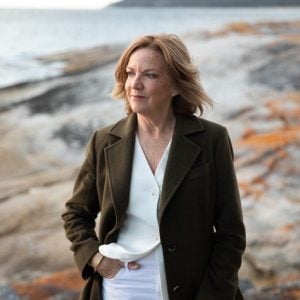
Hilary Burden is a British-born, Tasmania based author and perfumer at Undersong Tasmania who specialises in stories of place and nature. She is author of the bestselling memoir ‘A Story of Seven Summers’, and the acclaimed ‘Undersong – A Tasmanian journey into Country’. She lives under Whalers Lookout in Bicheno.
Images
1. mapali – Dawn Gathering: image by Sonja Ambrose
2. Hilary Burden: image by Melanie Kate Creative
One autumn evening in Launceston, I walked down the hill from my share-house to the Seaport. There – where...
Dear friends, On summer evenings the island hums. Sea breeze in the gums, music drifting across a park, kids...
What happens when a community takes the lead in telling its own story? In Shorewell Park, a suburb of...
We’re thrilled to share that our design partner, Futago, has been named a finalist in the prestigious BEST Awards...